High Varietal Concentration and Emerging Diversification Pathways
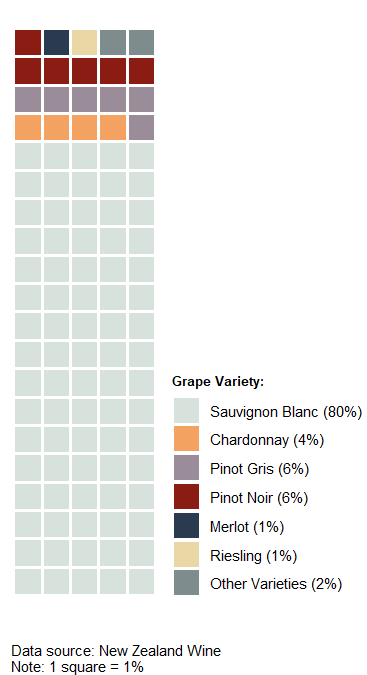
Sauvignon Blanc accounts for approximately 80% of New Zealand’s total wine production in 2025, making it the defining variety of the country’s wine industry. This level of varietal concentration is unusual among major global wine exporters and has supported strong country-of-origin recognition, particularly in the global premium white wine segment.
However, such concentration also implies structural vulnerability. Heavy reliance on a single varietal increases exposure to climate variability, viticultural disease risks, and potential shifts in global consumer preferences. From a portfolio perspective, this limits resilience and highlights the need for broader varietal diversification.
Pinot Noir currently serves as the primary red varietal, accounting for roughly 6% of production, benefiting from New Zealand’s cool-climate conditions and positioning the country as a credible competitor in the premium Pinot Noir segment traditionally dominated by Burgundy. In addition, Syrah may increasingly function as a strategic diversification candidate in the context of gradual climate change and shifting viticultural suitability, although its current production scale in New Zealand remains limited. Together, these red varietals represent potential pathways toward a more balanced and structurally resilient export portfolio.
New Zealand 2025 vintages
Asia as the Core Driver of Premiumisation
Despite relatively modest export volumes, Asia has emerged as the key premiumisation region for New Zealand wine. Markets such as Singapore, Hong Kong, and China consistently exhibit the highest export unit values, with prices in some cases approaching or exceeding NZD 20 per litre equivalent. In these markets, New Zealand wine has transitioned from a mass retail product to a premium consumption category, underpinned by on-premise dining and gifting-driven demand occasions.
China, in particular, represents a structurally important high-value market, where demand is supported by affluent consumer segments with a willingness to pay for differentiated origin and quality positioning. This reinforces Asia’s role as a strategic focus for value-led growth, where future expansion is more likely to be driven by price realisation rather than volume expansion.

In contrast, key Western markets such as the United States, the United Kingdom, and Australia remain the largest destinations by volume but continue to exhibit relatively subdued pricing dynamics. Export unit values in these markets have remained range-bound at lower levels over an extended period, reflecting a structural reliance on supermarket-led distribution channels. Within these channels, New Zealand Sauvignon Blanc is predominantly positioned as a high-turnover retail SKU rather than a premium offering.
This volume-dependent model results in heightened sensitivity to logistics cost inflation and retail margin compression, underscoring the strategic importance of continued diversification toward higher-yield, premium-oriented markets.
New Zealand Wine Industry Insights | Part One
Unlocking Value across Production and Markets

June 30, 2026 by Johnny Wang
Industry Implications
New Zealand wine is entering a structural transition from volume-led expansion toward value-driven growth. While Sauvignon Blanc remains the industry’s strongest global asset, its dominant position also creates concentration risk and highlights the importance of broader portfolio diversification.
At the market level, the divergence between Western volume markets and Asian premium markets suggests that future value creation will depend less on increasing shipment volumes and more on improving pricing power, brand positioning, and channel quality. Asia, particularly through premium consumption occasions, represents a strategic growth pathway where New Zealand wine can capture greater value from its established reputation for quality and origin.
For industry participants across the value chain, the strategic priority is therefore to leverage Sauvignon Blanc’s global recognition while building a more balanced portfolio and expanding exposure to higher-value markets. Long-term competitiveness will depend on the industry’s ability to convert brand strength into sustainable value creation through premiumisation, diversification, and deeper engagement with growth markets.
AGRICULTURE
-
Sauvignon Blanc remains the cornerstone of New Zealand wine’s global positioning.
-
High varietal concentration creates structural vulnerability and highlights the need for diversification.
-
Western markets provide scale but face pricing constraints.
-
Asia represents a key market for premiumisation opportunity for future value growth.
Key Takeaways
Next: China Market Opportunity
Asia represents a key pathway for New Zealand wine’s next phase of growth. Among these markets, China stands out for its demand resilience, premiumisation potential, and opportunities for portfolio upgrading.
Discover how New Zealand wine has performed in China and where the future value-growth opportunities are emerging.